Modern manufacturing moves fast. Can AI-based QA system be ready before every new run — even if the line reconfigures every day?
Duality's work in unstructured domains like drone detection and off-road autonomy has historically gotten more attention than a use case that, on the surface, looks completely different: manufacturing flaw detection. But the underlying problem and approach are closely related— and we've been achieving strong results in manufacturing QA for almost as long as Duality has existed.
Over the coming months, we'll share the tactics and results behind that work. This first post introduces the approach, through what it looks like for a common type of manufacturing customer.
A contract manufacturer producing packaging for dozens of brands might reconfigure its line every 24 hours — next customer, next product, next label. That's a brutal deadline for AI-based visual QA: any flaw detector needs real product images to train on, and by the time enough of those exist, the run they were meant for is likely to be over.
The standard approach carries real costs, in time and waste:
- Waiting for defects to occur naturally → gambling that enough show up before the run ends.
- Running defective product on purpose → burning real material and machine time on output that can't be sold — a cost some manufacturers can't justify at all.
Even approaches that only need images of ideal, defect-free product still require the line to already be running before the QA system can be built. So how can AI vision QA be deployed on a fast-turnaround run at all?
The answer starts with a simple shift: since Duality's training data is generated, not collected, there's nothing to wait for and no material to waste. More significantly, it means the flaw detection model can be built as soon as you know what product is coming next — well before the line is even set up to run it. And since Falcon combines data generation, model training, and performance validation into one workflow, the moment you know the specs, data generation is underway within minutes, with training and validation right behind it.
A Common Defect: Label Wrinkles
Let’s consider an example of a recent customer: a contract manufacturer whose lines apply labels to bottles at high speed (note: while this example focuses on label application, the same approach works for most manufacturing QA scenarios). Hardware inevitably makes random mistakes. Wrinkles, for example, often show up scattered, not in predictable batches. Ideally, they're caught the moment they happen, saving the team the time and effort of sorting through finished pallets.
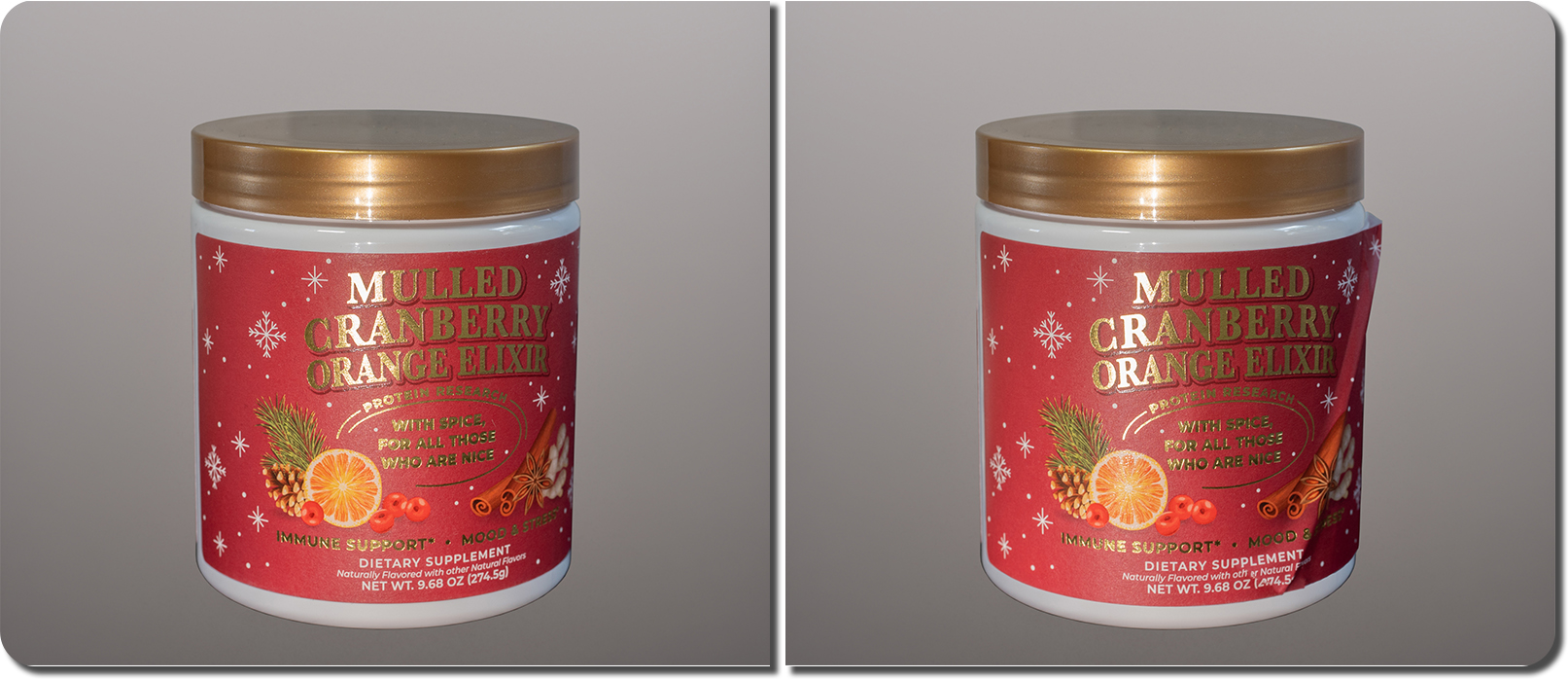
Problem: Today’s run requires the use of a different bottle - shorter and wider than the one previously produced and with an updated label. How can the manufacturer quickly train a new detector?
Common synthetic data methods will struggle with this flaw: a wrinkle isn't a texture that can simply be pasted onto a rendered label — it needs to physically pull and shift the material around it — which can produce different results on a different bottle shape. A 2D visual distortion can look like a wrinkle in isolation, but it won't behave like one in context, and a model trained on it won't work in the real world.
Digital Twin Solution: Falcon models the bottle and the label as physical objects that react to deformation. This is especially vital for good wrinkle data since the wrinkle and everything around need to move together the way a real label actually would.
With a few clicks, the customer is able to create a new virtual version of the bottle and label combination:
The needed defect can then immediately be introduced. One wrinkle of course isn't enough, an entire, accurate distribution of realistic ones (including perfect, non-defective examples) is needed. The pipeline has to reproduce a significant range of wrinkle types that this label material and application process can actually produce.
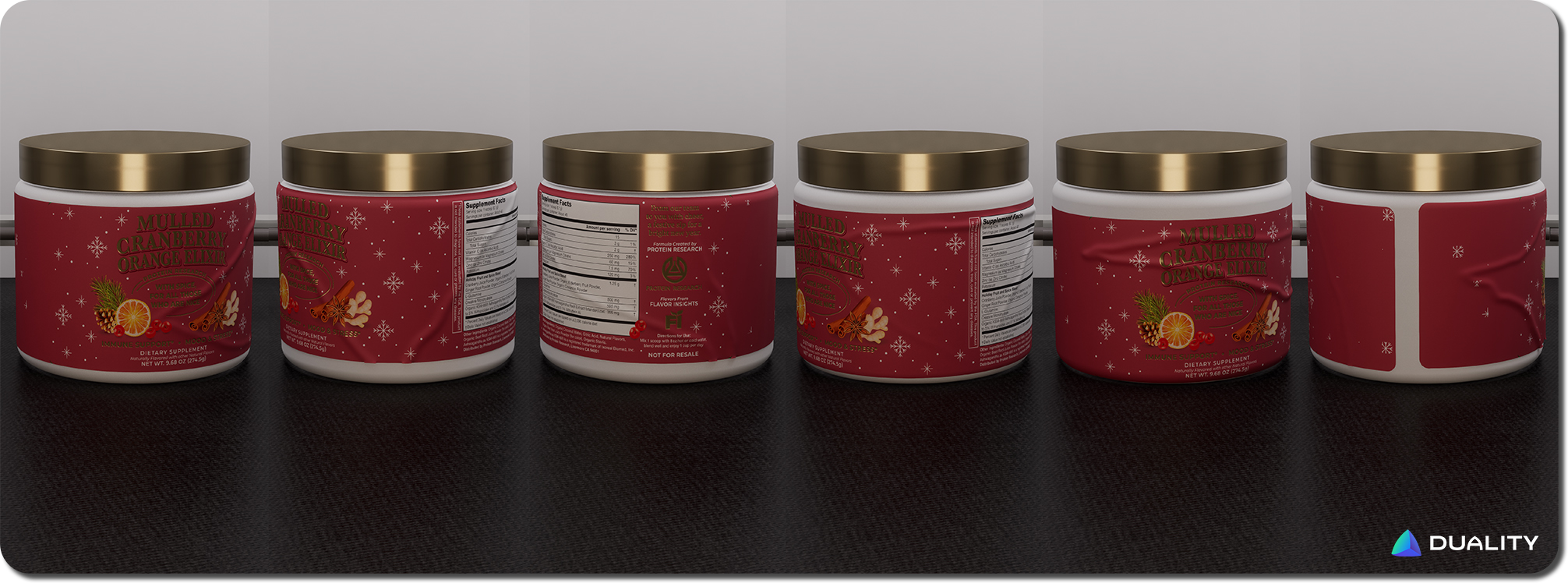
Procedurally Generated, Physically Accurate Defects
The key to our customers’ success with flaw detection lies in Duality’s approach to synthetic data: the Three I Framework — a systematic approach for crafting realistic and relevant synthetic data purpose-generated to improve AI model performance. In the case of wrinkle detection, far from hand-sculpting a wrinkle to look convincing, pasting in a 2D image, or simply modifying a single hero asset, we built a 3D wrinkle generator that utilizes physics-based modeling.
The deformations are generated to be physically accurate — With parametric inputs that allow for precise control over vast varieties of flaw generation, without producing random, implausible variations that can be common in generative approaches.
The result is a system that can produce vast amounts of physically plausible label behavior on demand.
And the approach is transferable: the same procedural system that generates wrinkles on this label can be pointed at a different label material, a different bottle geometry, or an entirely different failure mode (i.e. cracks, tears, misalignments) without starting over.
Matching the Real Environment, Not Just the Product
A perfectly accurate digital twin of the bottle, label, and defect still isn't useful if the synthetic images don't look like what the real inspection camera actually captures.
To address this, the digital twin of the product is combined with a digital twin of the inspection station itself, with the conveyor, lighting, and camera all tuned to match the real hardware's output. Closing that sim-to-real gap is what makes the synthetic data valuable for training a model that has to perform on the actual line, not just in simulation.
From Digital Twin to Deployable Model — Automatically
The above described flexibility of the procedural approach solves another hurdle specific to this manufacturer: they run dozens of distinct bottle shapes, paired with a variety of label stocks, printed with a wide range of brand graphics and messaging. On any given day, each line is running one specific combination of bottle, label, and graphics.
A single detector meant to handle all of them would just reintroduce the original problem: before it can be built, you still need data for every bottle it's supposed to work on. That leaves a manufacturer with a handful of bad options:
- Generate data for each bottle in advance
- Constantly work to add new models onto a central detector while trying not to degrade performance on the bottles it already handles well
- Build a federated model and absorb the added complexity that comes with it.
Our approach sidesteps all of it: This procedural approach enables the manufacturer to train a detector for today's specific bottle, in a few clicks. No need to anticipate every bottle or defect that may surface in advance, nor to get bogged down in ever more complex multi-model architecture.
Once the digital twins exist, the rest is a pipeline, not a project: Falcon generates the training images for the day's specific bottle, label, and graphics combination, trains the model, and outputs a ready-to-deploy wrinkle detector — all in a handful of clicks, before the run even starts.
Evaluating Detector Performance with Military-Grade Standards
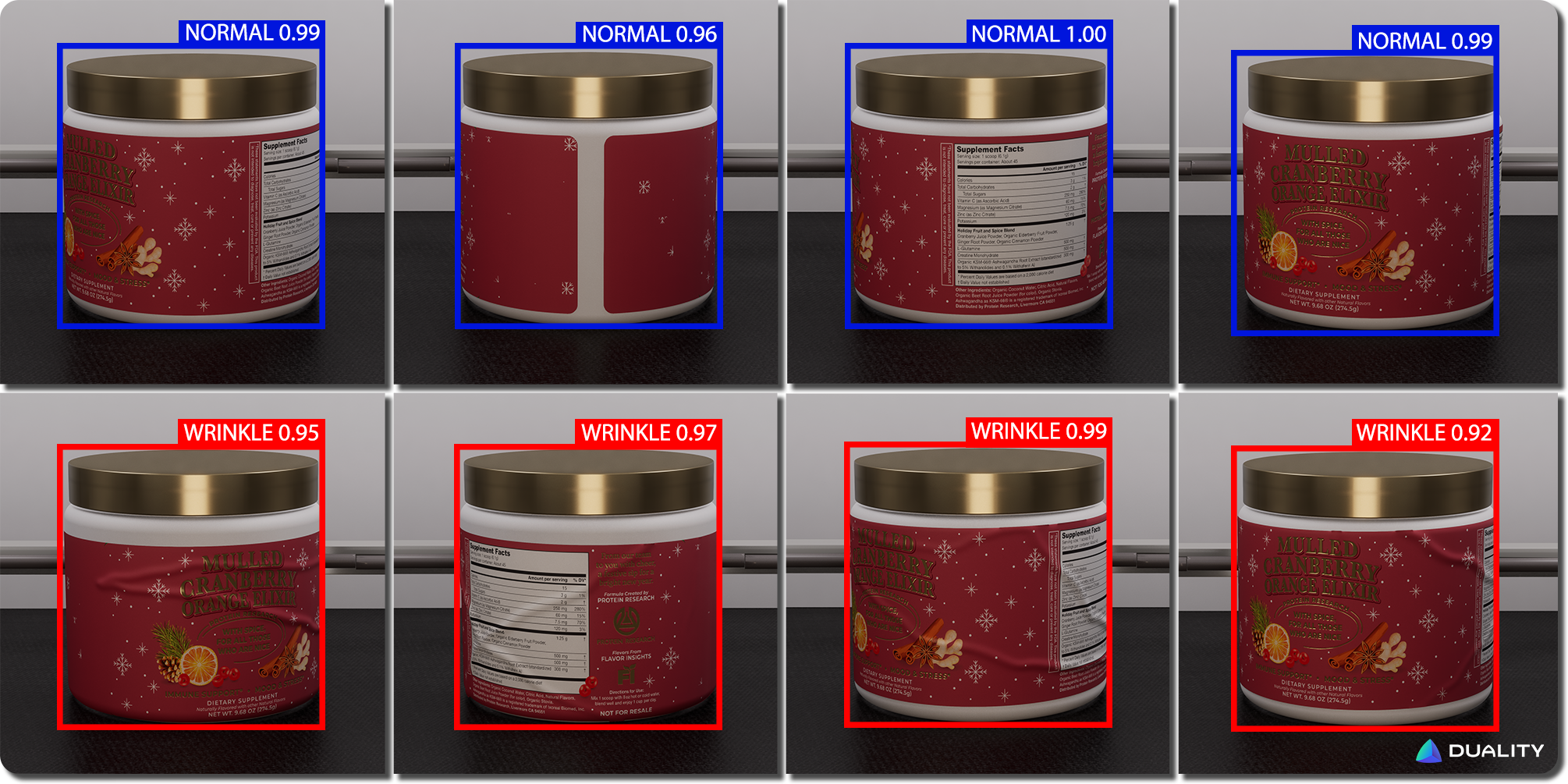
Once a flaw detector is trained, we need to ascertain whether it’s ready to be deployed on the production line. This evaluation, using real and synthetic data, can similarly be automated to produce comprehensive benchmarking of the model’s performance, and generate insights about limitations as well as data gaps that Falcon can fill in.
In our previous work with the military, we enabled AI models to overcome data limitations that were holding back quicker and earlier detection of hostile drones. In the process, we developed a virtual verification and validation (Virtual V&V) approach that has become central to our process of understanding model performance. We're now bringing that approach to all our customers.
The results of this virtual V&V is visualized in the form of a dashboard that is now utilized across most Falcon use cases. For a manufacturing QA application, it looks like this:
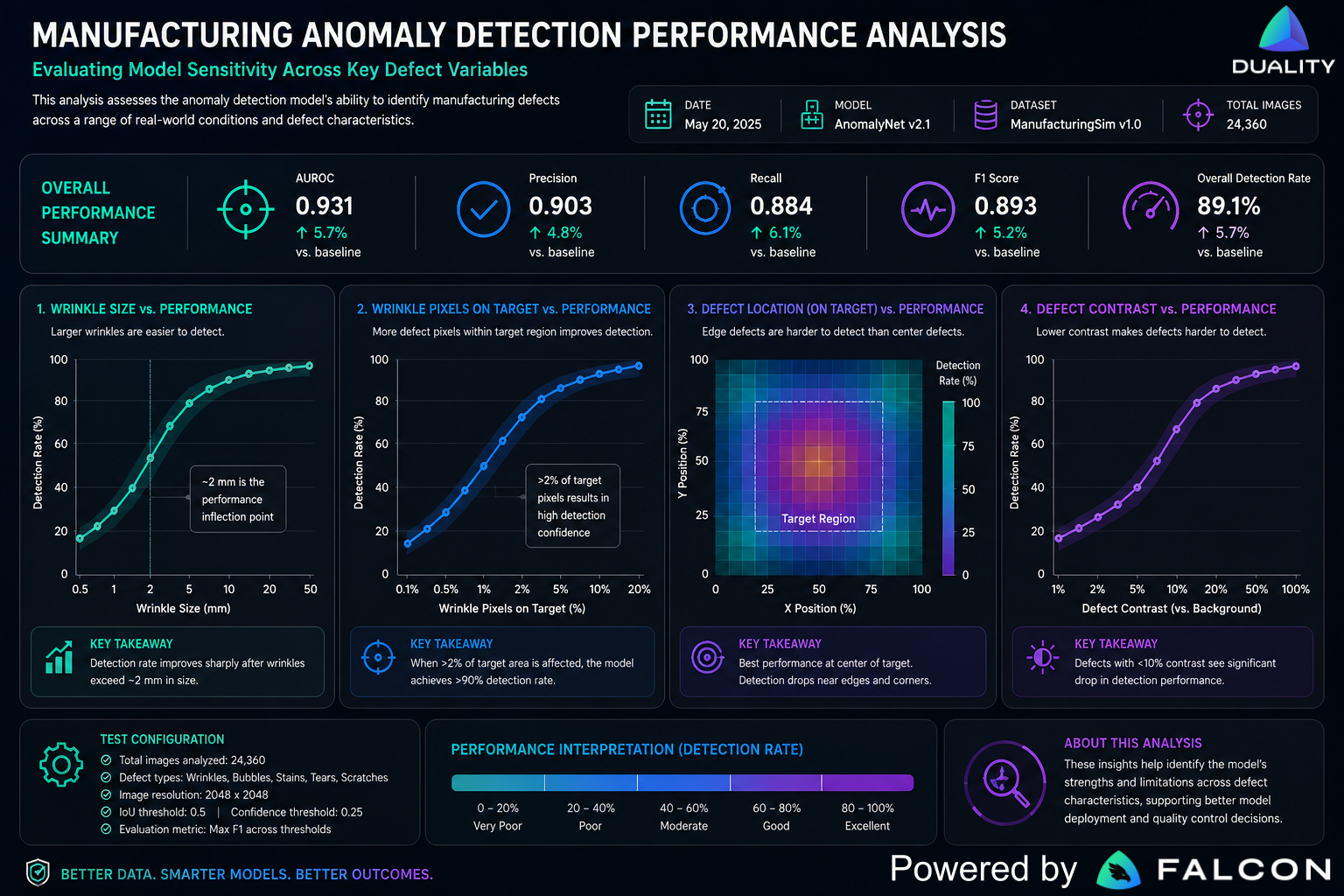
And why is such a comprehensive look needed? Model performance isn't something a single metric can capture. Each product use case and manufacturer priorities will differ from one another. How a detector performs as wrinkle size changes, for instance, matters just as much as its overall accuracy, and knowing that lets a customer choose the model tuned to what their specific task actually needs.
Reuse and Repurpose
It may seem obvious, but it is important to remember that digital twins don't get thrown away when the project ends. And this means they are an investment that keeps yielding results.
The inspection station digital twin can be reused as-is with a similar camera, or with sensor tuned for a different application. A bottle's digital twin is available for whatever the next QA problem on that bottle turns out to be. A changed conveyor or repositioned camera becomes a parametric adjustment, not a full-scale rebuild.
For a customer running hundreds of bottle-and-label combinations, that compounds fast — less rebuilding, less redundant engineering, a faster path to a working detector every time the application shifts.
Diverse Flaws, One Workflow
The underlying approach generalizes well past label wrinkles: any manufacturer running short, high-mix production needs a way to train visual QA models without waiting to accumulate real data first. That's really the throughline of this whole approach: a digital-twin-first pipeline never depends on gathering real data examples before it can start, so it's inherently faster than the traditional route, and it makes AI-enabled QA possible on the same timeline as the production run itself.
Ready to see how Falcon can solve your team's QA challenges? Let's chat: solutions@duality.ai