Today, we are introducing Falcon 6.3. This release introduces major updates, which include:
- Falcon Rearchitecture
- New Pulse-Doppler Radar Sensor
- MuJoCo Integration
- Unreal Engine 5.7 Migration
- Agentic Documentation Search
- Falcon MCP
Falcon has always relied on Unreal Engine as its operating system. That foundational decision, going back to 2019, was grounded in Unreal’s unrivaled rendering capabilities and the depth of its content ecosystem. Our customers, and the broader industry, have validated that choice many times over: Unreal has since become the dominant engine for robotics simulation.
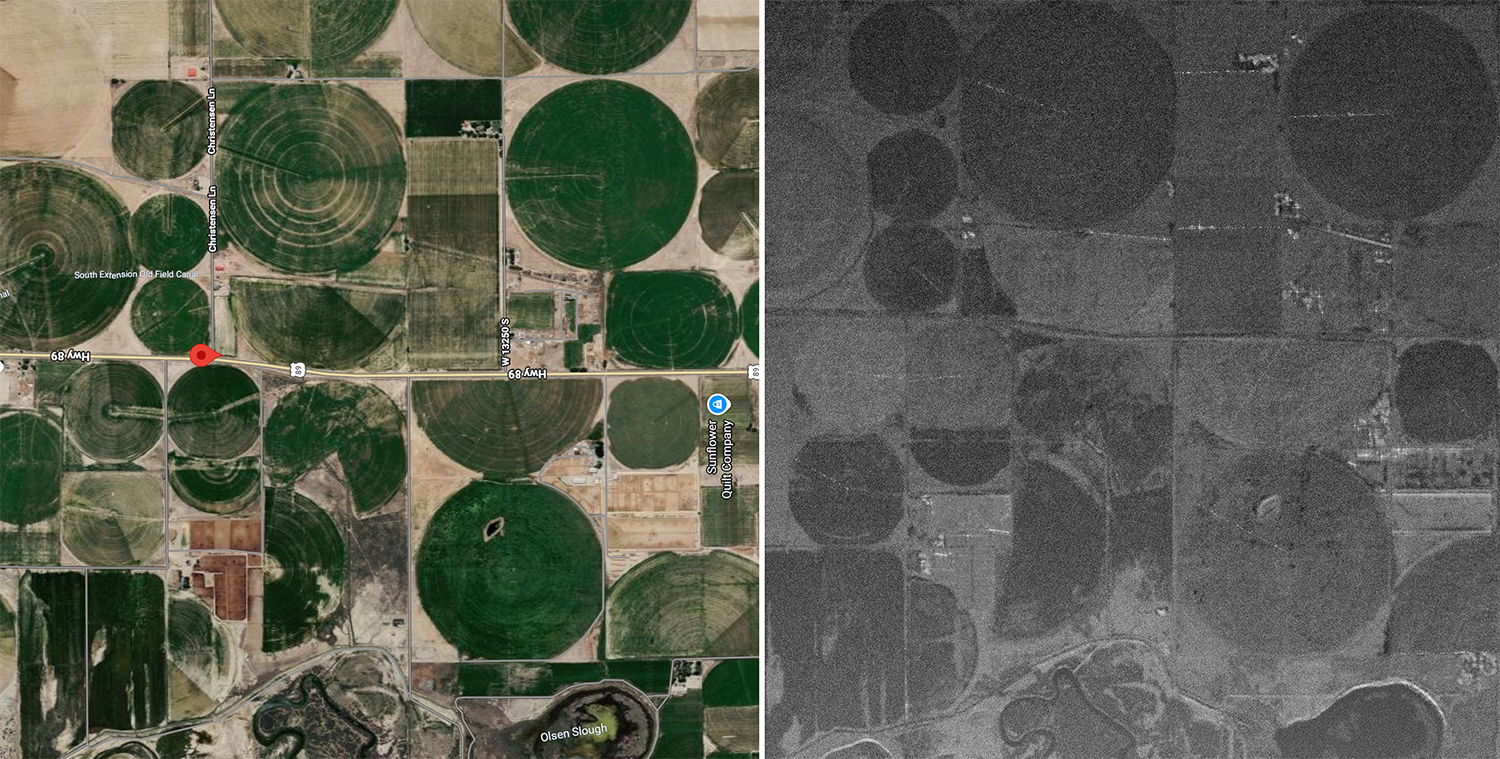
Our work has always pushed the envelope for what can be accomplished with UE-based simulation. Physically and visually accurate 3D worlds are the baseline; turning those worlds into sources of accurate multi-spectral sensor data is what matters. To do that, Duality maintains a custom fork of Unreal Engine, made possible through an OEM agreement with Epic Games. That fork is what powers Falcon's array of high-fidelity, multi-spectral virtual sensors, purpose-built for synthetic data that closes the sim2real gap.
Equally important is meeting our customers where they are. Duality consistently evolved Falcon for two groups:
- Engineers and researchers who want digital twin fidelity without requiring deep Unreal expertise
- The Unreal-native community, who work directly within familiar UE structures and benefit from a close alignment with those workflows
Much of our recent work has focused on the first category of users. VibeSim and FalconCloud now make digital twin simulation and synthetic data generation accessible without requiring deep Unreal skillsets. Anyone can compose scenarios, tune sensors, and generate data through natural language prompts and browser-based workflows. These tools will continue to evolve and keep making simulation accessible to even more users. But with Falcon 6.3, we’re revisiting the very foundations of the platform, and addressing friction points for the backbone of our users community, the Unreal experts.
Let’s dive in!
A New Foundation: Modular Systems
With Falcon 6.3 we’ve reworked Falcon fundamental architecture. Falcon's core functionalities (i.e. Python, DTES/USD, and Sensors) are now restructured into modular capability blocks that plug directly into Unreal Engine. With the new release, it's even easier for Unreal-native users to build simulations the way they already build anything else in Unreal, without need to engage with translation layers or alternative workflows.
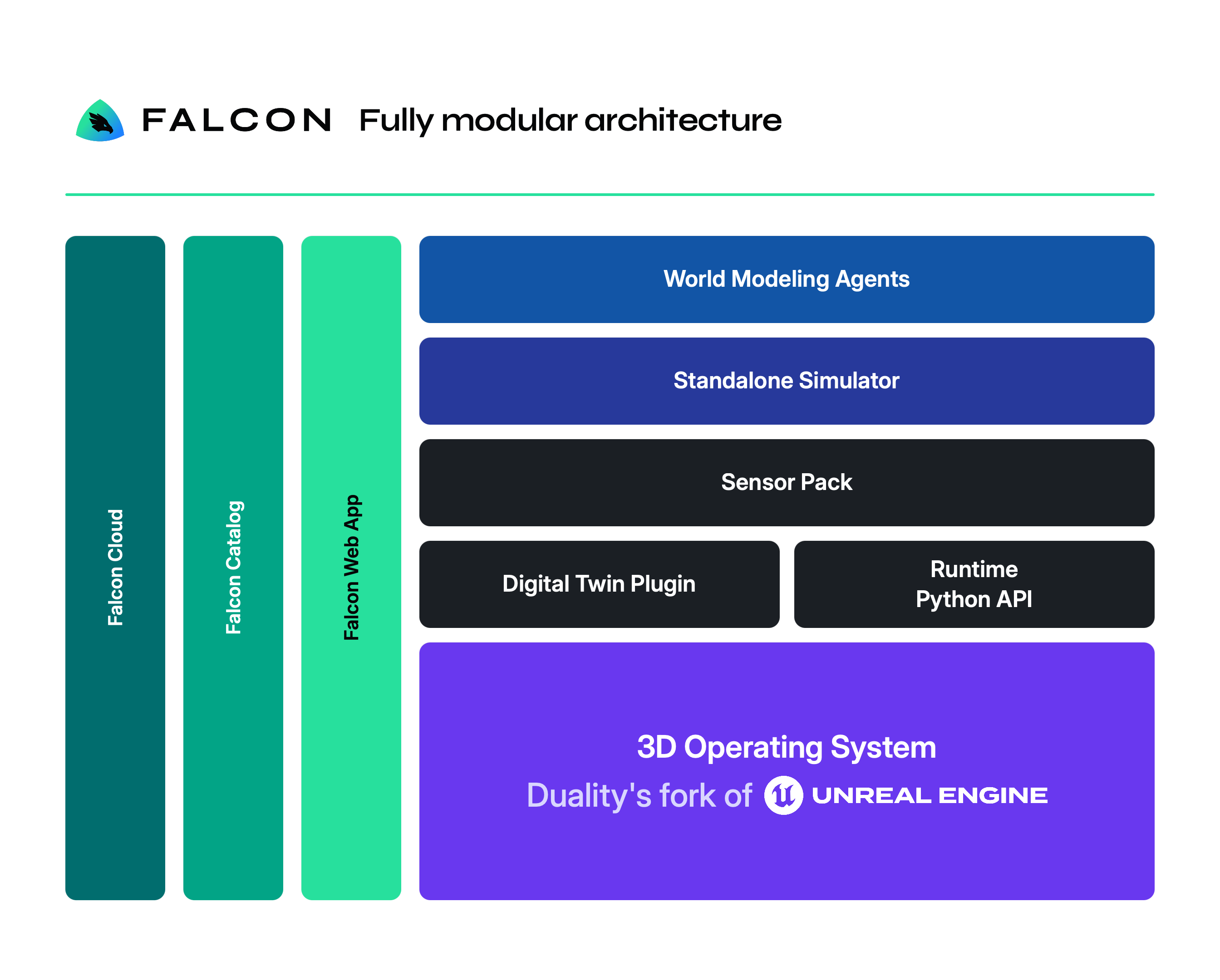
In addition to making Falcon even friendlier to standard Unreal workflows, this update also enables real performance gain for Falcon’s sensor library. Falcon has always generated sensor data by pulling data from just the level above Unreal’s rendering pipeline. While an efficient approach, it still added some overhead. Now Falcon reads the same raw graphics buffers Unreal's renderer works from directly, at the same level as the rendering pipeline rather than on top of it, and a GPU compute-shader plugin transforms that raw data into sensor output directly on the GPU. The result: sensor data generates faster, without an extra reprocessing step in the middle.
Under the hood, this update also closes the distance between Falcon's engine and vanilla Unreal Engine. Falcon has always run on a custom fork of UE (a core strength that enables capabilities like our virtual SAR sensor). But the more a fork drifts from the base engine, the harder it gets to adopt each new Unreal release. Falcon 6.3's rearchitecture into modular systems reduce that drift, enabling Falcon to adapt quickly to new Unreal advances and reducing the technical debt that often plagues other Unreal-based simulators.
Pulse-Doppler Radar (and RF Sensor Toolkit)
A high-priority goal for Falcon is to enable users to generate the synthetic data they need for their physical systems. Falcon already covers a meaningful slice of the electromagnetic spectrum, including visible light and infrared. With Falcon 6.3, we’re expanding into a new territory: radio frequency (RF). This new class of sensing, represented accurately in simulation, opens the door to new applications across commercial and government operational domains including autonomy, aerospace, maritime navigation, and more.
The above example shows a Falcon generated range-Doppler map with detection and target tracking of UAVs from a simulated scenario in which the sensor is mounted on a marine vessel.
Agentic Toolkit for Novel RF Sensors
While the Pulse-Doppler Radar is the first RF sensor arriving with today’s release, it’s only one part of the story. The above described pipeline that makes the Pulse-Doppler Radar possible, also unlocks a much larger range of RF sensor types and implementations, including support for: passive and bistatic RF sensing, communication link budgeting, and electronic warfare scenarios like jamming and spoofing.
To make it easier to build on that foundation, Falcon 6.3 also introduces the RF Sensor Toolkit, an agentic development workflow that helps turn user-defined sensor requirements into working RF sensors. Users can specify characteristics such as waveform, antenna geometry, desired output, and scan pattern, and the toolkit builds the sensor implementation using Falcon’s existing RF propagation and GPU signal-processing pipeline.
This is just the start of RF in Falcon. More RF sensors are coming in future releases. If you have RF sensor needs, we're interested in hearing what you’d like to see prioritized: specific radar types, communication-based sensors, and beyond.
High-Fidelity Mechanical Dynamics with MuJoCo
As we’ve noted previously, access to the Unreal ecosystem is a key strength of Falcon. As that ecosystem expands to better support the simulation community (new plugins, tools, integrations) we are making sure that Falcon makes it easy for engineers to take advantage of these capabilities in their existing workflows.
Native co-simulation is one example we’re bringing to Falcon 6.3, and we’re starting with MuJoCo.
Co-Simulation (MuJoCo)
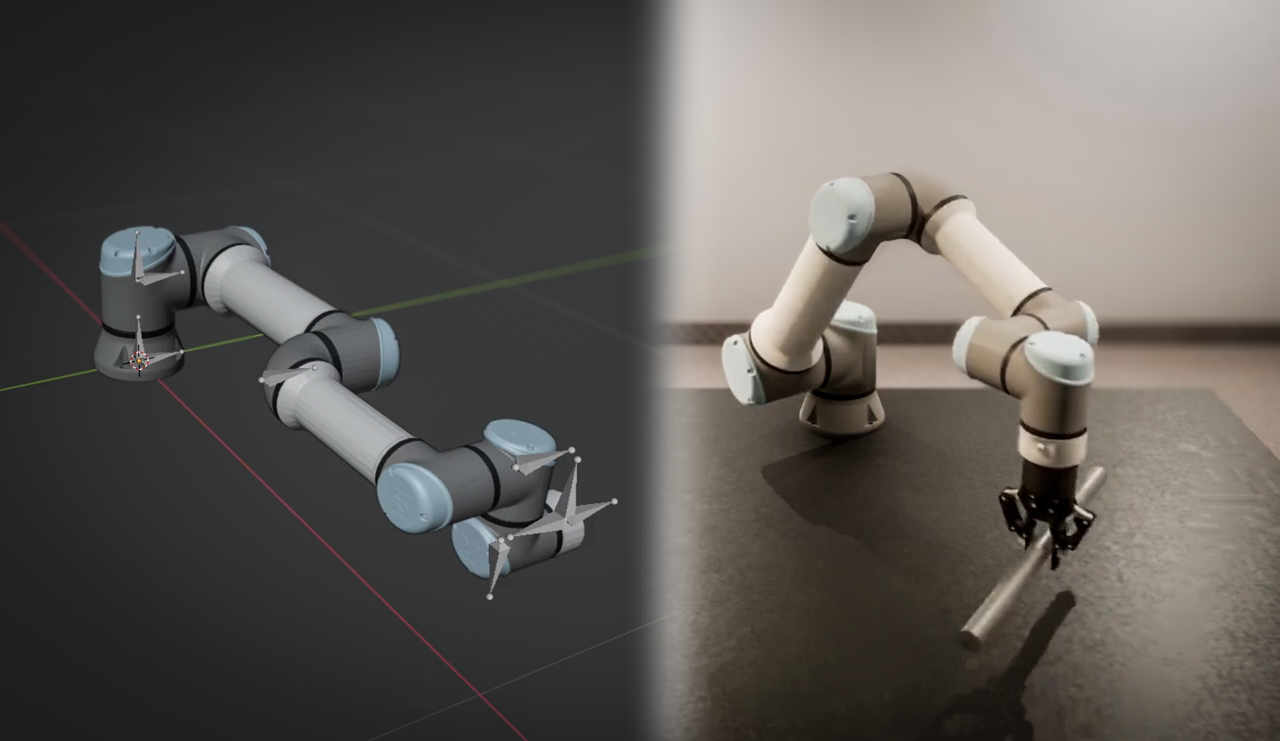
Recently, we shared how any URDF-defined robot can become a fully articulated Falcon digital twin. With Falcon 6.3, we're adding functionality to make it even easier to rapidly set up high fidelity robot simulation. With this new integration, MuJoCo co-simulation brings physically accurate mechanical dynamics to any robotic system digital twin.
MuJoCo (which stands for Multi-Joint dynamics with Contact) is a free, open-source physics engine maintained by Google DeepMind. It is designed for fast, accurate simulation of articulated structures interacting with environments, and is generally considered to be the industry standard for robotic simulation. Falcon’s new co-simulation integration is intended to make working with MuJoCo as seamless as it is to work with any other Falcon process, melding Falcon’s high fidelity 3D worlds and sensor streams with MuJoCo’s highly accurate physics — all with real-time performance.
This work builds on Unreal Robotics Lab (URLab), an open-source research project that embeds MuJoCo directly inside Unreal Engine. Falcon 6.3 takes this work further by bringing full, in process, Python scripting in the same process as the simulation, so users can drive articulations and actuators directly, without needing to stand up an external system, network channel, or any other complex configuration.
The above video illustrates the basics of this integration and how users can now drive robotic behaviors in Falcon via MuJoCo, using either a GUI or directly with Python behaviors.
While in early stages, the MuJoCo integration is available starting today for all users working with robotic systems in Falcon.
Unreal 5.7 Migration
Falcon always runs one version behind Unreal's current release. This cadence gives our team the chance to put each release through added QA and stability checks before our customers build on it. Customers get Unreal's richest feature set without the risk of running on a release with potential unknown issues. This is the same philosophy behind keeping Falcon's engine delta small: deliberate updates that keep Falcon close enough that closely keeping pace means not falling behind.
Unreal Engine 5.7 is focused on pushing environmental realism further while keeping performance stable at scale — richer, denser natural environments, more physically accurate materials, and more consistent lighting, without the usual tradeoffs those improvements normally cost. Alongside that, the release continues to streamline how large, detailed worlds get built, making world-building faster and less manual (read the full UE 5.7 release notes here).
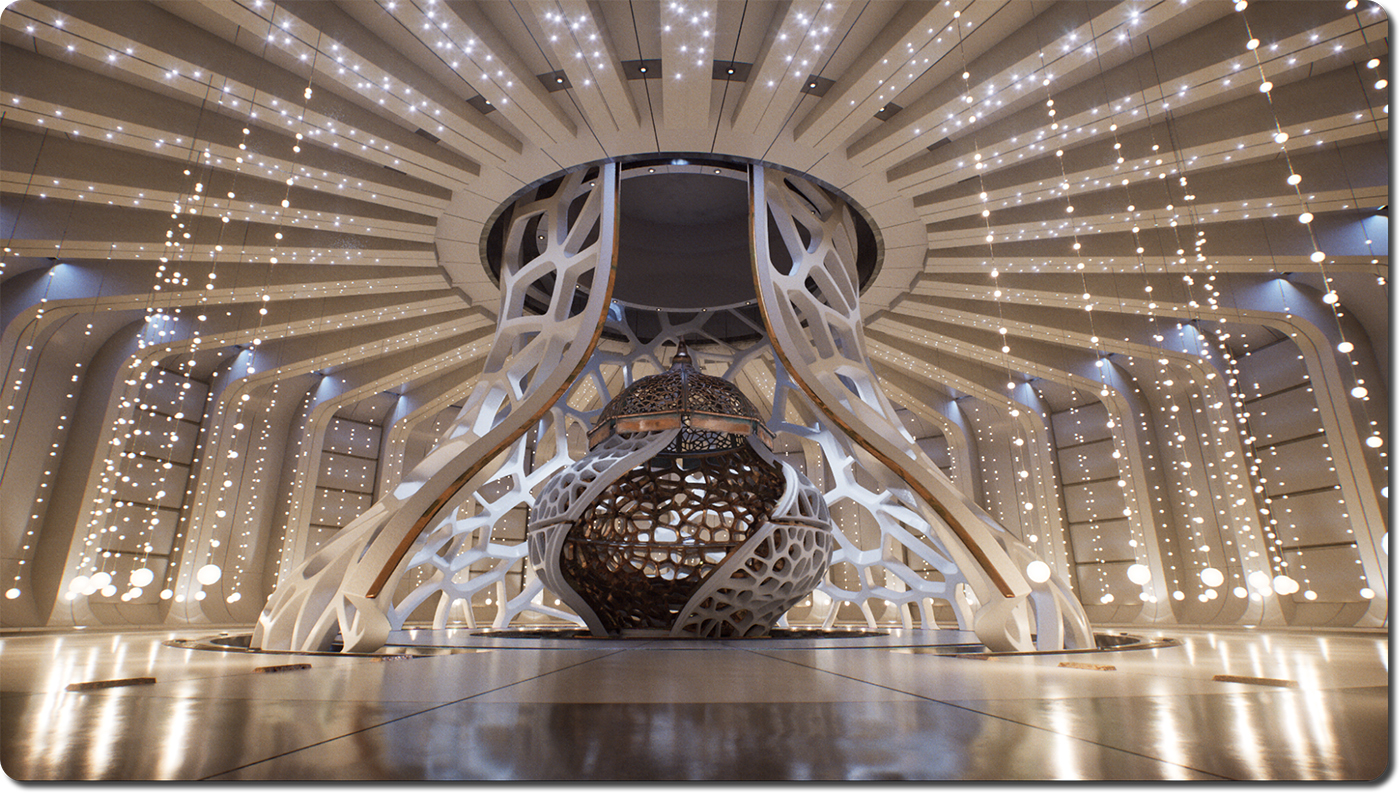
Of significant benefit to Falcon 6.3 is the production-ready Megalights feature, as well as new material improvements:
- MegaLights brings scalable dynamic lighting, and enables an order of magnitude more light sources in a scene than previously possible. For simulations with a large number of local lights (ex: projects modeling urban structures with high amounts of diverse light sources) we've seen gains of 30–40 FPS, a level of performance that wasn't achievable before.
- Materials Improvements: Unreal's continued work on physically accurate materials opens the door to more precise rendering of surfaces like automotive paints and glass — a meaningful benefit for the kinds of high-fidelity simulations Falcon customers rely on.
Duality Lighting System (Beta Release)
Falcon 6.3 introduces a new streamlined system that grants users easier and more precise control over time-of-day and weather conditions across any environment twin.
Duality Lighting System, or DLS, was built to standardize lighting across Falcon's environment twins with a system designed specifically for simulation with no dependency on third-party tools. The result is a simplified interface, both in FalconEditor and via Python, for controlling lighting and atmospheric conditions.
The real payoff, however, is physical accuracy: DLS is built around physically plausible lighting and exposure values, not just visually convincing ones. That gain is especially valuable for ray-tracing heavy workflows, where physically correct lighting directly drives accurate sensor performance.
Agentic Documentation Search
Like any enterprise platform, Falcon takes some learning to master. New features often mean new workflows. We work hard to maintain up-to-date docs that are as user-oriented as possible. With 6.3, finding the right answer in Falcon's documentation just got easier: a new AI-powered search now sits behind the docs. Powered by Google Gemini (the same model family behind Vibe Sim), agentic doc search is designed to dramatically streamline question answering on Falcon capabilities and workflows.
The new documentation agent is live starting today on FalconCloud.
Falcon MCP
In addition to the ease of scenario building and simulation execution made possible by Vibe Sim, in a growing number of our customer engagements, we see a compelling case for MCPs transforming the simulation landscape. When users can quickly combine disparate world models and agentic tools to custom fit their unique challenges (i.e., kitbash their world modeling approach), they can rapidly take advantage of some of the most advanced techniques in physical AI and robotics available today. Examples of these include working with Vision-Language-Action (VLA) models in simulation, or executing vital long-horizon training that isn't feasible in the real world.
Starting today Falcon 6.3 ships with an MCP server, packaged with Falcon Sim and Falcon Editor, that lets tools like Claude Code work directly with Falcon. This MCP is built on the same knowledge base as Vibe Sim, with the same grounded, up-to-date understanding of Falcon that powers our browser-based agentic simulation, and is now available directly inside your coding assistant, without leaving your terminal or editor.
In the near future we will dive further into how Falcon’s MCP is designed to work in concert with the new Unreal Engine MCP, a workflow that will be introduced with subsequent versions of UE.
Read the full release notes on FalconCloud.
Got questions for the team? Get in touch.